
Observed every third Thursday of November, World Philosophy Day invites travelers and thinkers to examine how different civilizations make sense of human existence and the natural world. In the West, philosophy was historically debated in open agoras and written in dense treatises, while European formal gardens—such as Versailles—used strict geometric symmetry and manicured hedges to showcase human reason mastering nature.
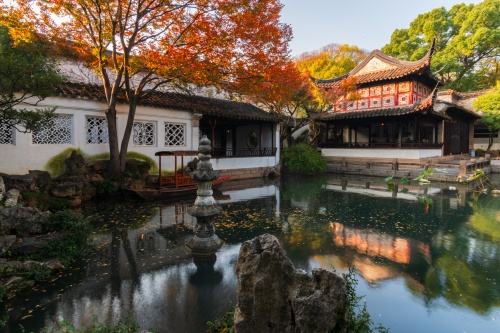
In China, classical philosophy took a completely different architectural path. Rather than imposing geometry onto the land, ancient Chinese scholars, poets, and imperial architects translated their deepest cosmological beliefs into stone, water, timber, and foliage. Guided by the Ming Dynasty master treatise Yuanye (The Craft of Gardens), every Chinese garden strives for one ultimate ideal: though made by human hands, it must appear as if created directly by heaven.
Walking through a classical Chinese garden is not a passive botanical stroll. It is an entry into a three-dimensional scroll painting where Taoist duality, Confucian ethics, and Zen Buddhist mindfulness converge at every turn of the path.
Taoism and the Architecture of Yin-Yang Balance
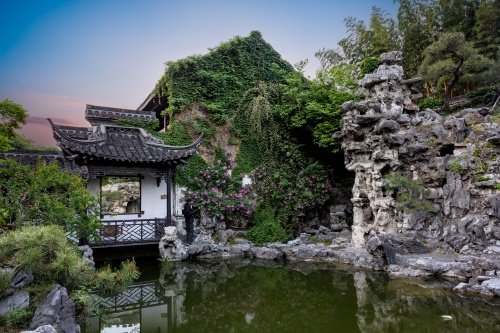
At the core of Chinese landscape design lies Taoism, which teaches that harmony arises from the dynamic interplay of complementary opposites known as Yin and Yang. In a classical garden, this philosophical concept is immediately visible in the dialogue between mountains and water—literally the Chinese word for landscape (shanshui).
Weathered limestone formations, particularly porous Taihu scholar rocks salvaged from lake beds, embody Yang: solid, vertical, unyielding, and structural. Yet the very holes and hollows worn through these rugged stones introduce Yin into the heart of Yang, allowing wind and moonlight to pass through solid rock. Surrounding these stone peaks are tranquil ponds that embody Yin: soft, horizontal, yielding, and reflective. Neither element can exist meaningfully without the other; the rock gives contour to the water, while the water brings movement and skyward reflections to the stone.
This Taoist balance extends to the built structures as well. Architects carefully alternate between solid pavilions (shi) and open, empty courtyards (xu), echoing the philosopher Laozi’s teaching that the usefulness of a vessel lies in its empty space. Whitewashed courtyard walls act as blank silk canvases, capturing the shifting shadows of bamboo stalks as the sun moves across the sky.
Confucianism and the Moral Order of Scholar Retreats
While Taoism governs the wild, naturalistic contours of a garden, Confucianism shapes its social hierarchy, family spaces, and botanical symbolism. Historically, China’s private gardens were built by retired civil officials and literati who sought a sanctuary from court politics without abandoning their moral cultivation.
The spatial layout of the main residence and central halls reflects Confucian ideals of social harmony and respect for ritual order. The primary reception hall always sits at the heart of the complex, facing south to welcome warmth and guests, where scholars gathered to compose poetry, play the seven-stringed guqin zither, and debate statecraft.
Even the trees and flowers planted outside these halls serve as living ethical reminders. Pine, bamboo, and winter plum—celebrated together as the “Three Friends of Winter”—are planted near study windows because they remain resilient and green during freezing weather, representing the upright integrity of a Confucian gentleman (junzi). Bamboo bends in the fiercest wind without breaking, teaching humility and resilience, while summer lotus blossoms rise unstained from murky pond mud, symbolizing moral purity amidst a complicated world.
Zen Buddhism and the Spatial Art of Mindful Illusion
How can a private urban courtyard covering barely two acres evoke the boundless majesty of mountains, rivers, and valleys? The answer lies in Zen (Chan) Buddhist contemplation, which holds that an entire universe can be perceived within a single flower or grain of sand.
To expand finite physical boundaries into infinite mental space, Chinese garden designers developed three ingenious spatial techniques that guide visitors into a state of present-moment awareness.
Borrowed Scenery (Jiejing)
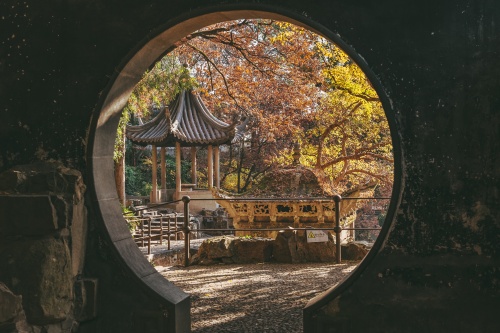
Rather than walling the garden off from the outside world, designers align sightlines so that distant pagodas, mountain ridges, or neighboring trees appear to be an organic part of the garden itself. At the Humble Administrator’s Garden in Suzhou, the silhouette of a pagoda standing over a kilometer away is seamlessly captured above the garden wall, uniting the finite courtyard with the vast horizon.
Framed Views (Kuangjing)
Circular moon gates, fan-shaped lattice windows, and hexagonal doorways slice the landscape into living vignettes. Instead of revealing the entire garden in a single panoramic glance, these architectural frames isolate specific compositions—a branch of autumn maple overhanging emerald water or moss-covered roof tiles dripping with morning rain—inviting the observer to pause and contemplate one fleeting moment at a time.
Winding Paths and Shifting Perspectives (Yibu Huanjing)
You will rarely find a straight walkway in a Chinese garden. Timber corridors twist and turn, and stone bridges cross ponds in deliberate nine-turn zigzags. By slowing the traveler’s physical pace and constantly shifting the angle of vision, every few steps reveal an entirely new composition, mirroring the philosophical journey of life where insight is discovered through the detours rather than a straight sprint to the finish line.
Experiencing Garden Philosophy in China: Scholar Intimacy vs. Imperial Grandeur
For international travelers, the most rewarding way to grasp Chinese garden philosophy is to witness the contrast between the intimate literati retreats of the southern water towns and the monumental royal parks of the northern capital.
Suzhou and Jiangnan: The Meditative Soul of Private Literati Gardens
Located in the lush lower Yangtze River delta just thirty minutes from Shanghai by high-speed rail, Suzhou is the undisputed capital of classical garden art. Its UNESCO-listed retreats—including the Humble Administrator’s Garden, the Lingering Garden, and the intimate Master of the Nets Garden—were crafted by Ming and Qing dynasty scholars as personal microcosms of nature.
Wandering through Suzhou’s gardens in the quiet morning hours allows you to experience philosophical introspection firsthand. You can trace covered calligraphy corridors, sit in waterside pavilions designed specifically for listening to the sound of raindrops on lotus leaves, and sip fragrant green tea where poets once meditated five hundred years ago. Pairing Suzhou with nearby Hangzhou’s West Lake and Shanghai’s heritage neighborhoods offers a complete immersion into southern China’s refined aesthetic heritage.
Featured Cultural Journey: Explore UNESCO-listed classical scholar gardens, historic canals, and lakeside tea culture on our private Shanghai, Hangzhou & Suzhou Classic Tour.
Beijing and Chengde: Cosmic Order and Grand Harmony in Imperial Landscapes
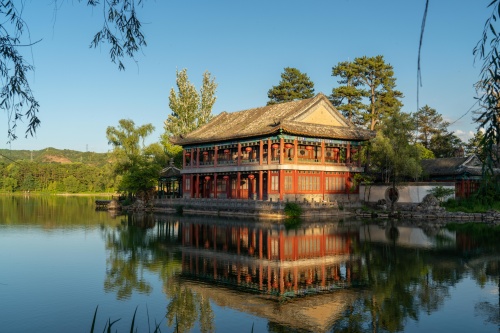
Five hundred miles north in Beijing and across the Yanshan Mountains in Chengde, garden philosophy scales up from private contemplation to imperial cosmology. Royal estates such as the Summer Palace (Yiheyuan) in Beijing and the UNESCO-listed Chengde Mountain Resort (Bishu Shanzhuang) were designed to project the Emperor’s mandate as the bridge between Heaven and Earth, uniting China’s diverse geographic terrains and cultural traditions into a single harmonious realm.
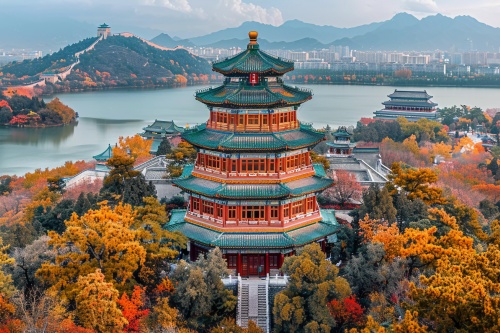
At Beijing’s Summer Palace, three-quarters of the grounds are dedicated to the vast Kunming Lake, while the excavated earth was used to shape Longevity Hill—a monumental execution of Taoist Yin-Yang balance between mountain and water. Continuing northeast by high-speed train to Chengde reveals the largest existing imperial garden in the world. Built by Qing Dynasty emperors as a summer seat of statecraft, the Chengde Mountain Resort intentionally mirrors the entire topography of China in miniature: misty lotus lakes and delicate island pavilions in the southeast evoke the scholar gardens of Jiangnan, wide open grasslands in the north reflect the Mongolian steppes, and forested peaks in the west embody the untamed northern mountains, all encircled by the grand Eight Outer Temples.
Featured Cultural Journey: Experience the grand cosmological design of the Summer Palace, the Forbidden City, and the vast landscapes of the Chengde Mountain Resort on our curated Beijing & Chengde Imperial Discovery Tour.
Philosophical Elements in Chinese Gardens: At a Glance
|
Philosophical School |
Core Concept |
Garden Architectural Element |
Symbolic Meaning & Purpose |
Premier Destination to Experience |
|
Taoism |
Yin-Yang Duality & Wuwei (Naturalness) |
Porous Taihu rocks paired with still mirror ponds |
Balancing solid structure (Yang) with fluid movement (Yin) |
Humble Administrator's Garden & Lingering Garden (Suzhou) |
|
Confucianism |
Social Harmony & Moral Cultivation |
Central reception halls & "Three Friends of Winter" plants |
Honoring family order, hospitality, and resilient integrity |
Master of the Nets Garden (Suzhou) & Prince Kung’s Mansion (Beijing) |
|
Zen Buddhism |
Mindfulness & Infinite Microcosms |
Moon gates, lattice windows, and zigzag stone bridges |
Slowing human steps and framing the beauty of the present moment |
West Lake Tea Gardens (Hangzhou) & Classical Courtyards (Suzhou) |
|
Imperial Cosmology |
Harmony Between Heaven, Earth & Humanity |
Artificial mountains overlooking expansive lakes |
Uniting diverse regional landscapes under one harmonious realm |
Summer Palace (Beijing) & Chengde Mountain Resort (Hebei) |
Frequently Asked Questions: Exploring Chinese Classical Gardens
Q: What is the main philosophical difference between Suzhou gardens and Beijing imperial gardens?
A: Suzhou gardens emphasize inward reflection and scholarly seclusion, whereas Beijing imperial gardens express outward cosmic order and sovereign harmony. Suzhou’s private retreats use compact spaces, winding corridors, and optical illusions to create a quiet world away from society, while Beijing’s royal parks use vast lakes and towering temples to mirror the grandeur of the empire.
Q: When is the best time of day and season to visit classical gardens in China?
A: Arriving right at opening time between 7:30 AM and 8:30 AM offers the quietest, most meditative atmosphere for experiencing garden philosophy. While gardens are intentionally designed to showcase seasonal beauty year-round, spring brings blooming magnolias and wisteria, while late autumn transforms maples and ginkgo trees into vivid gold and crimson reflections across the ponds.
Q: Can travelers combine Beijing’s imperial gardens and Suzhou’s scholar gardens in a single itinerary?
A: Yes, high-speed bullet trains connect Beijing directly to Suzhou and Shanghai in just four and a half to five hours. CITS offers seamless multi-city cultural tours and can also design a 100% tailor-made private itinerary linking northern imperial landmarks with southern water towns, complete with expert local historians and private transfers.