
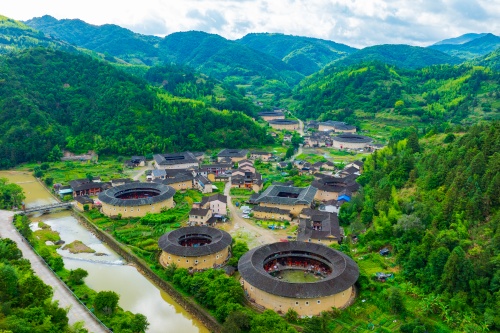
Hidden among the mountains of southwestern Fujian are some of China’s most distinctive traditional homes: the Fujian Tulou.
Circular or square, several storeys high and built around shared courtyards, these massive earthen buildings were designed for far more than shelter. Many functioned as entire communities under one roof, bringing generations of families together within a shared living environment.
Today, Fujian Tulou offer travelers a rare opportunity to explore not only an unusual form of Chinese architecture, but also a centuries-old tradition of communal living shaped by family, landscape and local culture.
What are Fujian Tulou?
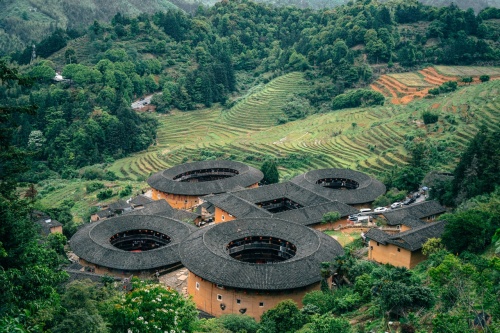
“Tulou” literally means “earthen building.” Scattered through the mountainous areas of southwestern Fujian, Tulou are large residential structures traditionally built with thick rammed-earth walls, timber frames and tiled roofs. Many are circular, while others are square or rectangular.
The UNESCO World Heritage property known as Fujian Tulou includes 46 representative buildings across several locations in Fujian. They are recognized for their distinctive architectural form, defensive features and tradition of communal living.
Some Tulou were large enough to accommodate hundreds of residents. Rather than functioning as individual houses, they could operate almost like small villages enclosed within a single structure.
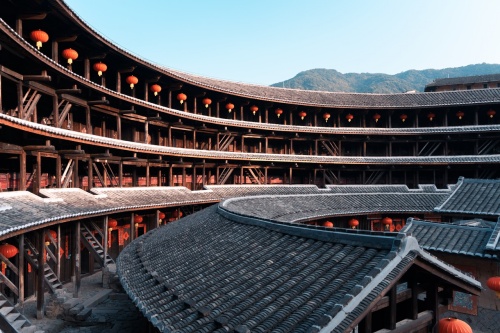
From the outside, the walls appear solid and defensive. Inside, wooden galleries, family rooms, ancestral spaces and an open central courtyard create a shared world facing inward.
How did communal living work inside a Tulou?
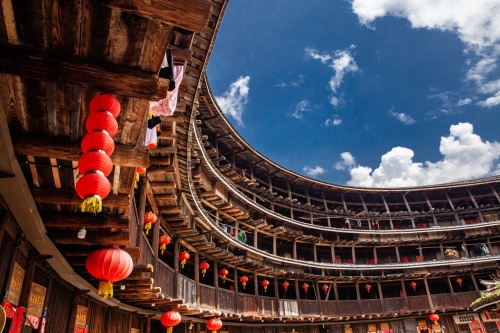
The most fascinating part of a Tulou is not simply its circular shape. It is the way that shape organizes daily life.
Rooms were commonly divided among individual families, while corridors, stairways, wells, courtyards and other spaces were shared.
This created a balance between private and communal life. Families had their own living spaces, yet everyday movement constantly brought neighbors and relatives into contact. Children crossed the same courtyard, residents used the same galleries and entrances, and family gatherings often took place in shared spaces.
The central courtyard was particularly important. Unlike a conventional house where rooms may face outward toward the street, Tulou rooms and galleries generally face inward toward the shared center. In this sense, the courtyard was more than an architectural feature. It was the social heart of the building.
Why were Tulou built this way?
Their form was shaped by both community needs and the surrounding environment. The thick earthen exterior walls provided protection and helped create a strong enclosed structure. Traditionally, many Tulou had relatively few openings on the lower exterior walls and usually one principal entrance.
Inside, timber construction created a very different atmosphere from the monumental exterior. The circular and square forms also adapted to Fujian’s mountain valleys, where villages developed among forests, terraced fields and farmland.
This relationship between architecture and landscape is one reason Fujian Tulou are especially striking when seen from above. They do not appear isolated from their surroundings. Instead, earthen walls, fields, villages and mountains form one continuous cultural landscape.
Are Fujian Tulou Hakka buildings?
Fujian Tulou are often associated internationally with Hakka culture, and many well-known Tulou communities are indeed connected with Hakka families. However, “Fujian Tulou” is the more accurate general term for this architectural tradition.
Not every Tulou should simply be described as a “Hakka village,” and Tulou itself refers to a type of building rather than an ethnic group. For travelers, this distinction is useful: Tulou can first be understood as a traditional form of communal architecture, while individual villages reveal different family histories, customs and local cultural traditions.
Where can travelers see Fujian Tulou?
Tianluokeng Tulou Cluster
Tianluokeng is one of the most recognizable Tulou landscapes in Fujian. Viewed from the surrounding hillside, its group of circular and square buildings is popularly nicknamed “four dishes and one soup” because of its unusual arrangement.
The elevated viewpoint is one of the best places to understand how Tulou sit within the surrounding mountain landscape. Nearby, travelers can also explore Yuchang Lou and walk through Taxia Village to see more of the region’s traditional settlement pattern.
Chuxi Tulou Cluster
Chuxi offers another perspective on Tulou life. Rather than focusing on one iconic building, the village presents a broader collection of earthen houses surrounded by terraced fields and mountain scenery.
Jiqing Lou is among its best-known historic buildings, and the elevated viewpoint over Chuxi shows how circular and square Tulou developed together as part of a wider rural community.
For travelers interested in architecture rather than simply photographing one famous landmark, Chuxi is particularly rewarding.
Are Fujian Tulou still lived in today?
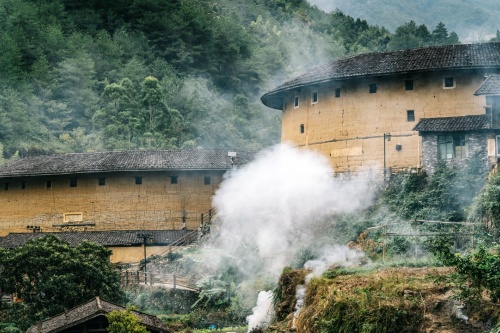
Yes. Some Tulou remain part of active village communities, although patterns of residence have changed significantly over time. That living dimension is an important part of their appeal.
These are not simply historic monuments. Laundry may still hang from wooden galleries, residents move through courtyards, farmland surrounds villages and traces of everyday rural life remain visible around the buildings.
Travelers are entering places connected to real communities, so respectful behavior is important. Ask before photographing residents closely, avoid treating private homes as exhibition spaces and follow local guidance when entering residential areas.
What is it like to travel through Fujian Tulou country?
A good Tulou journey should not be rushed. The experience changes considerably between an elevated viewpoint, the massive exterior wall and the interior courtyard. From above, Tulou appear almost geometric.
At ground level, their scale becomes clearer. Step inside and the building becomes more human: timber balconies, narrow stairways, family doors, lanterns and open courtyards reveal how daily life was organized. The surrounding villages are equally important. Tea fields, terraces, rural roads and mountain landscapes help explain why the buildings developed where they did.
Spending a night in the area can also offer a different perspective from a quick day trip, allowing travelers more time to experience the villages and surrounding landscape at a slower pace.
Explore Fujian Tulou with CITS
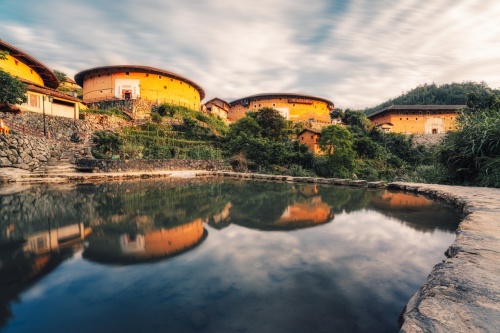
For travelers who want to explore several different Tulou communities rather than visit a single site, the CITS 6-day Fujian Tulou journey combines important Tulou areas with experiences in Xiamen.
The journey visits Tianluokeng Tulou Cluster, Yuchang Lou and Taxia Village before continuing to Chuxi, where travelers can see Jiqing Lou, terraced fields and the wider village landscape.
The itinerary also includes local cultural experiences and overnight stays in the Tulou area, offering more time to understand the relationship between architecture and community life.
The journey concludes in Xiamen, creating a contrast between Fujian’s mountain settlements and its coastal culture.
Frequently Asked Questions (FAQ)
Q: What does “Tulou” mean?
A: Tulou literally means “earthen building.” The term describes a traditional type of large residential structure built primarily with rammed earth and timber.
Q: Are all Fujian Tulou circular?
A: No. Circular Tulou are the most visually famous, but square and rectangular forms also exist.
Q: Where are the best places to see Fujian Tulou?
A: Nanjing and Yongding are two of the main areas for travelers. Tianluokeng and Chuxi provide particularly good examples of Tulou clusters and surrounding village landscapes.
Q: Are Fujian Tulou still inhabited?
A: Some Tulou remain part of active village communities, although the number of permanent residents varies from building to building.
Q: How many days are recommended for a Fujian Tulou trip?
A: A day trip can cover one main cluster, but spending two or more days in the region allows travelers to visit different Tulou communities and experience the surrounding villages at a slower pace.
Q: Can a Fujian Tulou trip be customized?
A: Yes. The itinerary can be customized according to your travel schedule, interests and preferred combination of Tulou villages and other Fujian destinations.