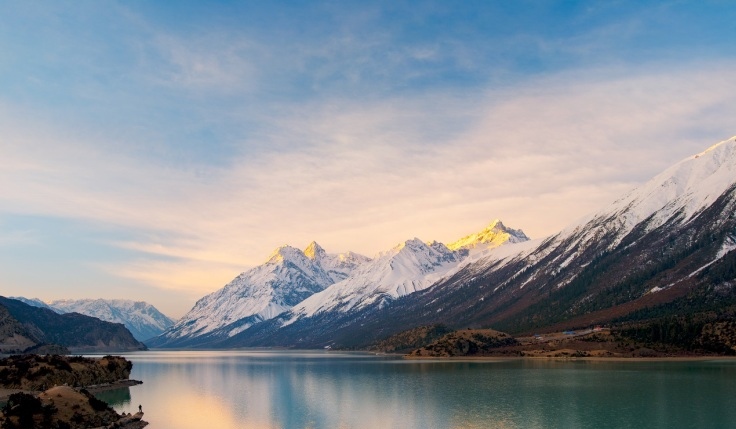
Located at the west suburb 15 kilometers from Kunming City, the West Hill extends a distance of more than 40 kilometers at an altitude of between 1900 meters to 2350 meters above sea level. It likes a beautiful lady laying beside Dianchi Lake with her face upward and her hair trailing into water. That is why it got another name 'Sleeping Beauty Hills'. You can see the outline of her face, chest, and legs clearly.
Legend
A tragic story related to the West Hill said that in remote time, a pretty princess escaped from the palace to seek freedom and love. The girl later met her prince and they got married soon. Unfortunately, their marriage encountered the king's strong opposition, who later killed her husband. The princess was so sorrow that she cried days and nights and tears fell from her face and formed the Dianchi Lake. The girl's body formed the West Hill.
Highlights
The major sites of the West Hill include Dragon Gate (also called Longmen) with a collection of Taoist caves and sculptures; Huating Temple, an ancient Buddhist temple; Taihua Temple, a temple with charming courtyard; Sanqing Pavilion, a Taoist temple; The Graveyard of Nie Er ( a famous Chinese composer). Meanwhile, the West Hill has also enjoys great fame for its beautiful and unique natural scenery since ancient time.
Dragon Gate
Dragon Gate is the largest and the most beautiful Taoist grottoes in Yunnan Province. The gate and passageway were carved out of the steep cliffs, featuring danger, tranquility and uniqueness. It was built in the Qing Dynasty more than 200 years ago, with a construction of 72 years. They were constructed by the skillful craftsmen living at the foot of the West Hill.
You can take a bird-eye view of the grand Dianchi Lake from the spot of the Dragon Gate. There is a saying that 'If you do not visit Western Hills, you haven't visited Kunming; if you do not come to Dragon Gate, you haven't been to Western Hills.'

Huating Temple
Located at the foot of the Park, Huating Temple is one of the major Buddhist temples around Kunming. Huating Temple covers an area of 120,000 square meters and mainly consists of a Living Pond, a Heavenly Guardians Hall, a two-tiered courtyard, and the Majestic Hall. What is most eye-catching for Huating Temple is the Grand Buddha in the Halls and the wood carvings that depict the household stories of the ‘Journey to the West’ (one of the Four Great Classical Novels of Chinese literature).
Taihua Temple
Taihua Temple gained its name for it is located on Taihua Hill. Originally built in the Yuan Dynasty (1206 - 1368), the temple is the oldest one in Western Hills. Daxiong Baodian Hall, Piaomiao Pavilion, Sizhao Hall are in the temple. The temple is famous for the beautiful rare flowers on the grounds. It is also a good place to watch the grand spectacle of the rising sun.
Sanqing Pavilion
Sanqing Pavilion or Sanqing Temple was first built in the Yuan Dynasty as a Summer Palace for Lingwang King, the fifth son of Kublai Khan. So Sanqing Temple is also nicknamed Liangwang Pavilion. “Sanqing” is said to be the utmost fairy land in Daoism, where three top immortals live, namely God of the Prime Origin, God of the Sacred Jewel and God of the Way of Power. Nowadays, it has been converted to a tea house for visitors to take a break.